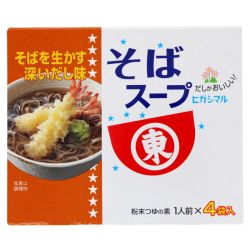
The word tsuyu broadly refers to an accompanying sauce or broth, while mentsuyu — men meaning “noodles” — is formulated more specifically for Japanese noodles.
Its soy sauce base is balanced with dashi, which may be prepared with dried bonito, kombu, shiitake mushrooms or a combination of several ingredients.
Bonito-free recipes are also available and offer a more plant-based flavour profile.
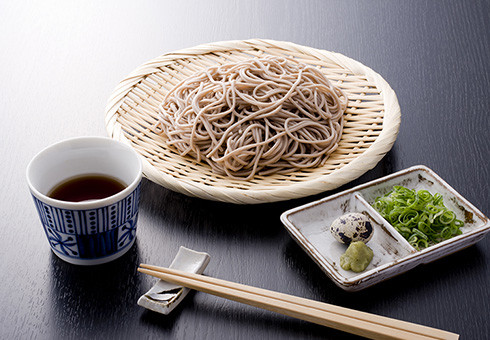
For cold noodles, tsuyu is generally served fairly concentrated in a small dipping bowl: the noodles are dipped into it bite by bite, as with zaru soba.
For a hot dish, it is diluted further to make a broth that can be drunk. The proportions vary considerably depending on the product and its concentration: a ready-to-use tsuyu is not measured in the same way as a base concentrated two, three or five times.
Some manufacturers therefore provide several dilution ratios, one for a cold sauce and another for a hot broth. It is best to begin with the ratio recommended for your chosen use, then adjust it with a little water according to the intensity you prefer.
The dashi determines much of the character of the tsuyu.
Bonito brings a distinct marine flavour and a lingering finish. Kombu provides a milder umami, while shiitake adds a deeper, woody note.
When choosing a tsuyu, you should therefore consider both the type of dashi and the concentration level.
A versatile base can also be used to season a donburi, a simmered dish or a tempura dipping sauce, but its main purpose remains the simple and precise preparation of broths and sauces for Japanese noodles.