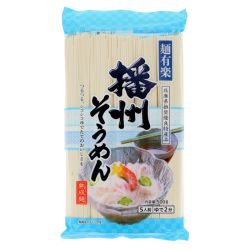
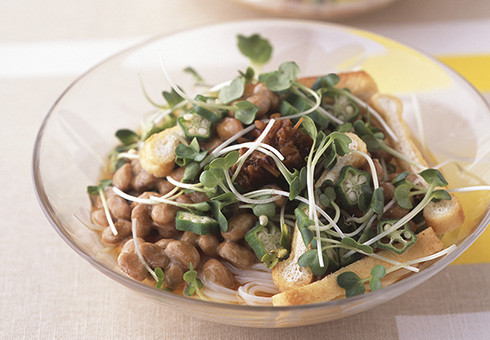
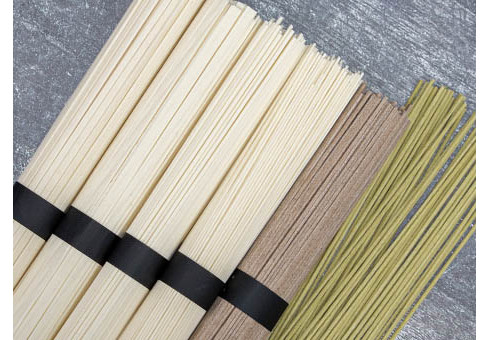
In Japan, somen are closely associated with summer meals. These long, white noodles are very fine and light, and are most often served cold, sometimes even presented over ice cubes.
Hiyamugi belong to the same family of wheat noodles, but have a slightly larger diameter.
Somen (素麺) and hiyamugi (冷麦) are generally made with soft wheat flour, water and salt. For conventional dried noodles, their name depends mainly on their thickness: somen measure less than 1.3 mm in diameter, while hiyamugi measure between 1.3 and 1.7 mm.
This distinction is less strict for certain hand-stretched noodles, which explains why the names may sometimes overlap.
Somen are particularly delicate and cook very quickly, while hiyamugi remain fine but have a slightly firmer texture. Soba somen also exist, combining the fine shape of somen with a dough containing buckwheat. They are therefore closer to soba noodles. The much thicker udon and kishimen offer a completely different texture. Our guide to Japanese noodles explains these distinctions in greater detail.
After briefly cooking them in a large volume of water, somen and hiyamugi should be drained immediately and rinsed thoroughly under cold water.
This rinsing removes excess starch, stops the cooking process and gives them a cleaner, firmer texture.
They are traditionally served cold and dipped bite by bite into a tsuyu sauce, accompanied by spring onion, grated ginger, shiso, nori or sesame seeds.
In winter, somen can also be served in a hot broth, in which case they are known as nyûmen (煮麺). Simply cook them for slightly less time, then add them to the broth just before serving to prevent them from becoming too soft.
They can also be stir-fried with vegetables, particularly in Okinawan somen champuru.