Filter By

Availability

Availability

Origin

Origin

Konjac and Shirataki

In Japan, konjac is not simply presented as a light alternative to pasta: it is a traditional ingredient that has long been appreciated for its firm, elastic texture. Available as blocks or shirataki noodles, it is served in broths, Japanese hot pots and simmered dishes.

Konjac (蒟蒻, konnyaku) is made from a tuber that is ground into flour, then mixed with water and an agent that gives it its characteristic texture.

Its flavour is very subtle: its main appeal lies in its chewiness and its ability to gradually absorb broths and seasonings. White konjac retains its natural colour, while black konjac generally owes its colour to the addition of seaweed.

With its very high water content, the products offered here have a particularly low energy value of around 5 to 10 kcal per 100 g. Its glucomannan content, a fibre naturally found in the tuber, also explains its popularity in light meals and its reputation as a filling food.

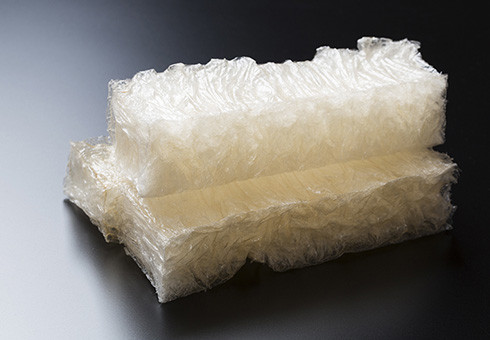
Konjac mainly comes in two forms: ita konnyaku (板こんにゃく), presented as a block, and ito konnyaku (糸こんにゃく), shaped into fine noodles and now generally called shirataki (白滝), although they were not originally exactly the same product.

Konjac is approximately 97% water. It is therefore packed in liquid to preserve its moisture, elastic texture and shelf life.

The smell when the packet is opened may be surprising. It mainly comes from the alkaline agent used to set the konjac and does not mean that the product has spoiled. The liquid in the packet should not be consumed.

Simply drain the block or shirataki, rinse them once or twice, then place them in boiling water for a few minutes if you wish to remove most of the smell.

After opening, any remaining konjac can be placed in a clean, closed container, covered with fresh water and kept in the refrigerator. It is best consumed within 48 hours. Freezing should be avoided, as it considerably changes the texture.

Ita konnyaku blocks

The block, known as ita konnyaku (板こんにゃく), can be cut into slices or cubes, or torn by hand to create an uneven surface that holds sauce more effectively.

After draining and rinsing it, briefly boiling it or heating it in a dry frying pan helps reduce its storage smell.

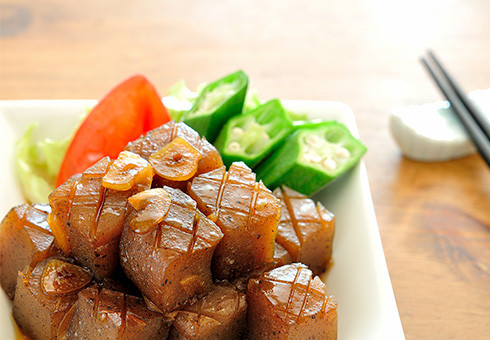
It can then be simmered in a dashi broth, nimono, curry or nabe and oden. Its texture remains firm even after prolonged cooking and pairs particularly well with vegetables, Japanese tofu and other simmered ingredients.

Shirataki konjac noodles

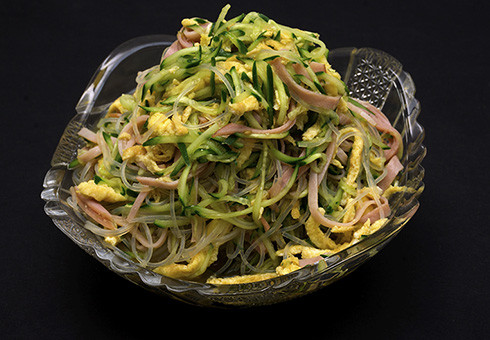
Shirataki (白滝) are fine konjac noodles. They are traditionally used in sukiyaki, Japanese hot pots and various dishes served in broth.

They can also be served cold in salads or stir-fried with sauce and vegetables. As they contain very few calories and almost no carbohydrates, they have also become a popular alternative to conventional noodles. Shirataki konjac noodles are available in white, black or tied formats, with the tied version being particularly convenient for simmered dishes.

Gunma Prefecture is Japan’s leading konjac-producing region. Its soils, relatively mild summers and dry winters are particularly well suited to growing the tuber, which takes several years before it can be harvested.
Satsuki therefore naturally favours konjac and shirataki produced in this region, particularly around Shimonita, which is known for its expertise. This choice also has a personal meaning for us, as part of Satsuki’s own roots are in Gunma.
Active filters