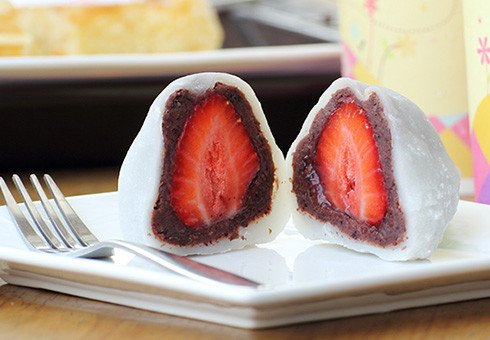
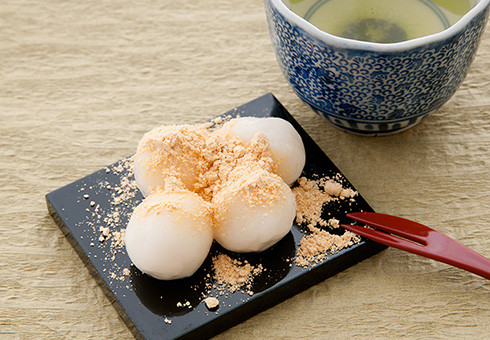
Japanese mochi is a preparation made from pounded glutinous rice, known for its dense, supple and elastic texture. In Japan, it can be eaten plain, grilled, added to soup or made into confectionery. In France, the word “mochi” mainly refers to small round filled sweets that are, more precisely, daifuku.
Mochi is one of the oldest rice preparations in Japanese cooking. It is traditionally made with Japanese glutinous rice, or mochigome, which is soaked, steamed and then pounded until it forms a completely smooth dough. This collective process, known as mochitsuki, remains particularly associated with the New Year.
Mochi is then used to make kagami mochi, presented as an offering, or served in ozôni, a soup whose recipe varies between regions and families.
Koshian provides a perfectly smooth centre, while tsubuan retains more of the beans’ texture. Mame daifuku contains whole beans in its outer layer, while yomogi daifuku is flavoured with Japanese mugwort.
Ready-to-eat mochi reproduce this characteristic texture in traditional or much more modern recipes.
Azuki, black sesame and matcha sit alongside taro, fruit, creams and chocolate.
Depending on how they are made, their dough may be soft and melting, slightly sticky or have a firmer chew. Products designed for longer storage are not always made in the same way as freshly pounded mochi: their recipe may combine glutinous rice flour, starches, sugar and other ingredients that help preserve their softness.
Taiwan also has a long-standing culture of glutinous rice cakes, shaped by Hakka traditions, local specialities from the east of the island and Japanese influences.
Taiwanese manufacturers have gradually specialised in filled mochi that can remain soft at room temperature and withstand long journeys.
These recipes are particularly well suited to export, unlike fresh Japanese daifuku, which harden quickly and have a short shelf life.
Depending on the product, they use glutinous rice flour, different starches and sugar to achieve a soft, elastic texture.
Traditional azuki, sesame and matcha fillings sit alongside taro, fruit, creams and chocolate. These Taiwanese mochi are therefore not fake Japanese mochi, but a local and modern interpretation of the same family of glutinous rice sweets.